
Charlie Foran was born and raised in Toronto. He holds degrees from the University of Toronto and the University College, Dublin, and has taught in China, Hong Kong, and Canada.
He has published twelve books, including five novels. His fiction, non-fiction, and journalism have all won awards. Mordecai: The Life & Times, published in 2010, won the Charles Taylor Prize, the Hilary Weston Writers’ Trust Prize, the Governor General’s Award, and a Canadian Jewish Book Prize. In 2011, the Globe and Mail declared the biography “probably the single most awarded book of any genre in the history of Canadian literature.”
Charlie has also written and presented radio and TV documentaries. A past president of PEN Canada, he is a senior fellow at Massey College, University of Toronto, adjunct faculty in the graduate faculty, Department of English, U of T, and a sessional lecturer in the Celtic Studies and Creativity and Society programs. He has been a member of the Order of Canada since 2014.
Charlie Foran served as CEO of the Institute for Canadian Citizenship (ICC) from 2015-2019 and Executive Director of Writers’ Trust of Canada from 2020-2024. In fall 2026, he is once again teaching courses on literary adaptation and contemporary Irish fiction at the University of Toronto, as well as serving as mentor in the MA in English in Creative Writing program.
He lives in Port Hope, Ontario.
*
In 2018, Charlie was awarded the Writers’ Trust Fellowship. The juy citation read:
“The range, depth, and beauty of Charles Foran’s work is an astounding feat. Few authors in Canada or the world write as eloquently or expertly about literary lions and hockey legends; about the Irish Troubles and post-Tiananmen Square China; about lives caught in the public gaze of history or in their most intimate encounters. In a body of work that spans the tail end of one century and the beginning of another, he’s proven just as adventurous in his choices of genre — moving in and out of fiction, literary nonfiction, journalism, biography, criticism, and advocacy for freedom of speech and diverse societies. The Writers’ Trust salutes and welcomes to its fellowship an indispensable voice in Canadian literature, a masterful storyteller who has helped us understand ourselves and the world around us one book, one essay, one campaign, at a time.”
A video was made:
**
I rarely post full interviews. But this summer 2026 conversation with Dara Vandor seems worth sharing on this site.
How to Write: Charles Foran
In which a great Canadian author explains his process, and we discuss inspiration, the joys of being edited, and male-on-male literary violence.
Sep 23, 2026
Charles Foran has made me cry.
I am not someone who is prone to weeping, and am certainly not someone who enjoys it. Truth be told, I find it mildly shameful when my eyes start to water, and I immediately try to talk myself out of feeling any deep emotions before the tears start to fall.
Reading Charlie’s 2023 book, Just Once, No More, was a one-way ticket to the waterworks. I want to be clear that the book is no downer. Rather, it gives form to that which is often formless: impermanence and loss, grief and mortality. It is Charlie’s ability to attach words to these complexities that provoked such a strong reaction in me. While I resent being made to feel my feelings, I can’t help but admire the talents of the writer.
Charlie’s oeuvre is wide, spanning novels, journalism, travel writing, essays, memoir, and biography, including the bestselling Mordecai: The Life & Times. And FYI, not all of his books have made me cry. To steal from the Writer’s Trust description of his work: “Few authors in Canada or the world write as eloquently or expertly about literary lions and hockey legends; about the Irish Troubles and post-Tiananmen Square China; about lives caught in the public gaze of history or in their most intimate encounters.”
We sat down to discuss inspiration, the joys of being edited, and male-on-male literary violence.
Sausage is a reader-supported publication. To receive new posts and support my work, consider becoming a free or paid subscriber.
DV: How did you come to be a writer?
CF: Short answer: I am still trying to become one.
Long answer: I wrote. And wrote. And then some of what I wrote started to be not terrible. Then some of it started to be okay. Then some of it even started to be pretty good. Pretty much where things stand now, 44 years since publishing my first short story – some of what I write is pretty good.
Describe what you write, and how you write it. I am particularly interested in how you come up with ideas, how you start… walk me through from conception to completion.
I haven’t any ideas, per se. What settles into my head, usually over a long period of time, is the architecture of a project. The blueprint for it. Here is a story I want to tell and, as importantly, here is how I want to tell it. For me, form is much more than scaffolding. It *is* the book, in effect, or at least it frames the questions I want to explore.
How do I start? By the time I’m finished, I usually can’t remember. But openings must be right; all else follows. Always, I begin with a scene, sometimes a fragment, sometimes an entire story unto itself. Scenes launch a novel with force. Voice then carries the novel past those buzzy opening pages.
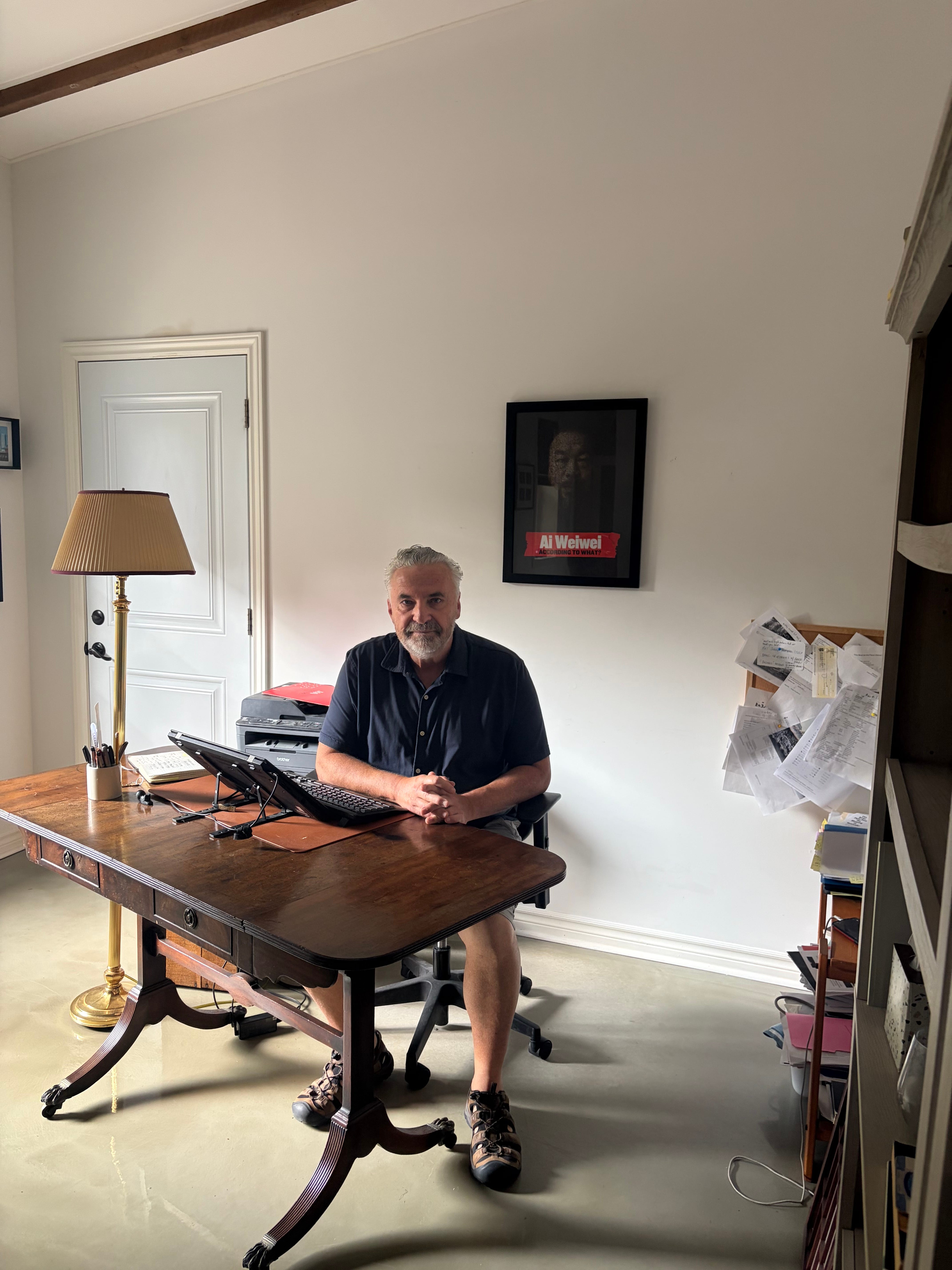
What are your essential tools to do what you do?
Is your own mind a tool? Is your own voice? If you write literary novels and literary non-fiction, as I do, these are, I suppose, the essential tools, and all of them are hand-crafted and ill-shapen and of no practical use to anyone else. Building anything using such amateur equipment is risky. Little wonder so many books fall apart. But those that don’t… where greatness lies…
Mind and voice aside – do you write on a computer? Could it be any computer? I could also see you being a hand-written notes guy.
My handwriting is illegible, and has been for decades. From the outset, I was on a typewriter, first manual then electric. I switched to a computer as soon as I could afford one.
What makes a great piece of writing?
The form of it, for sure. But foremost, the voice. How the writer is in the world perceptually, aesthetically, intellectually, emotionally, ethically. How they use language – its own tricky business – to impose themselves on the page. Great writing unites a mercurial individual conscience with the collective hunger to hear from others, to talk difficult things out, to get down, per Van Morrison, to what is really wrong. Ultimately, it is music made together.
What are your thoughts about edits? How graciously do you accept them?
The older I get, the more I want to be edited. Novels are a thousand aesthetic decisions made on your own. You’re not going to get them all correct. Also, at some point, usually well into a project, you’re writing in a blizzard, visibility near nil, barely keeping on the road. A good editor can keep you from driving into a ditch – or maybe off a cliff.
How much do you care what others think of your work?
When working on a book, I only think about what other books might think about it. The dialogue, for me, is with authors and work I revere. The tradition, I suppose. Once a book is published, well, then I start to worry about those other “others.”
What does that look like, the worrying about other others?
Reviewers, foremost. I am a naturally open and generous reviewer – or was, back when I did that kind of work. Rule #1 was do not review the novel YOU would have written and rule #2 was please, please spare us your undergrad capacity for barb and bite, in lieu of adult insight and understanding. Male-on-male literary violence, a staple of the tedious swordsmanship of the 20th century literary scene, back when men dominated it, was SO boring. Regrettably, it lingers, and I would much rather not be reviewed than reviewed by these forever clapped out guys.
What about inspiration? Do you believe it necessary to work?
That word eludes me – “inspiration.” I’ve never sought it, never cultivated it, never felt it other than abundantly everywhere all the time. Who isn’t inspired by the astonishing, immense, wondrous world around us? Waking up every morning, opening your eyes, should be enough. It is for me.
Who are the writers that make you green with envy? Who was the first writer that electrified you?
Whose talents do I revere? So many, and the list is forever growing. A near-random selection: Zadie Smith. Martin Amis. David Mitchell. Margaret Atwood. Lu Xun. Haruki Murakami. Samuel Beckett. Anne Enright. Michael Ondaatje. Toni Morrison.
Who first electrified me? Gabriel Garcia Marquez.
I want to stick on Margaret Atwood for a second, who looms large in my own personal canon. I think she’s a titanic genius, and haven’t stopped saying it since I first cracked one of her books in my teenage years. What I do wonder about is why there is no heir to that throne. Where’s the mid-40s Canadian literary wunderkind?
Atwood is astonishing, in every respect. A major novelist, poet, critic, and, from time to time, prophet. Any one of a dozen of her books would be the book-of-a-lifetime for someone else. For instance, Negotiating with the Dead, a series of lectures on writers and writing she published in 2002. A work of virtuosic intelligence and learning. And yet, minor Atwood, if not largely unknown, even to her fans. That is the scale of her extraordinary career.
As for the mid-40s literary wunderkind, there are lots of talented mid-career Canadian writers. At a guess, the steady decline in general readers of literary work during this century, its own unfolding disaster, coupled with the way ‘our’ literary scene fractured and splintered, has made it harder for folks who do care about writing in Canada to know where to look and who to pay attention to. The diminishment of book coverage in legacy media hasn’t helped either.
How long can you work uninterrupted, and how do you deal with interruptions? I seem to recall you once telling me that you structured your day into 45-minute blocks of time. Did someone teach you how to work?
In Zadie Smith’s essay collection Intimations, she mentions how before the pandemic she mentally divvied her day into 45-minute increments, the better to maximize her time. Reading that, I suddenly realized I’d been doing the same thing, probably since around age eighteen. 24 one-hour increments for one 24-hour day. To always get more done, squeeze more in. To not waste a moment, except, sadly, those 6-7 hours given to sleep. This was how I rolled for a long, long time. But I wonder, especially of late, with my own attention span being frayed by digital addiction and the Algorithm and whatnot – is this any way to write a proper book? Concentration is everything to putting good sentence after good sentence. The harder you concentrate, in the sense of giving yourself over entirely to the task, your mind almost empty otherwise, the more likely you’ll write those sentences and paragraphs and chapters. These distracted days, I think I *do* need someone to teach how to get and stay in that creative pocket. Any suggestions?
I was struck by something another guest, Alex McLeod, mentioned on this topic. He said that since he was a child of the 80s, he has effectively grown up with an Internet Brain. He didn’t see it as an impediment. One of the axioms I come back to time and time again is Daumier’s “il faut être de son temps.” If my audience’s attention span sucks, and mine also sucks, I need to stop pretending my audience is from 1926 rather than 2026. I need to get down to business faster, both in creating and communicating. If you can stay in that creative pocket for 20 extremely productive minutes, I don’t see why we need to make it a point of pride that we did, say, two hours of semi-productive time. This is me shilling for the HIIT Brain Workout.
I suspect I am just that much older than your other guest. My brain is pre-Internet and so is my way of creating. It might be different if I was ‘talking to’ the Digital Age in my work, something I did do, once, in a novel called Planet Lolita. But that was the exception that proves the rule of how I am on the page.
Best and/or worst advice you’ve ever gotten, with respect to your work?
Best advice was also maybe the worst: Lean on the work, a writer friend once said, not the career.
Seems pretty cogent – why do you see it as the worst?
Experience, I guess, much of it hard(ish) won. If you won’t, or perhaps can’t, lean on your career, who will? Worse, doing the work – or perhaps believing in the work in the right way to keep pushing yourself, keep learning, keep taking the necessary risks, etc. – is impacted over time by career limitations. Or so I’ve observed in others, and felt in myself.
What do you wear when you work? Does it differ from when you’re not working?
Plain clothes for plain prose? I hope not.
How quickly can you go from a completed project to a new one?
I used to shift from project to project immediately, almost in haste, as though if I stopped writing I’d never start up again. Now I take years between books and years more writing books. Turns out there isn’t any hurry, most things crumble to dust, so at the very least make sure what you do publish is all it could be and all you could be too.
Can you re-read your old work?
No. I only see the failings, on repeat. And here is the thing – the book is done. Over. Can’t be altered. Same for the author who wrote it. He’s gone too. That said, I did recently re-read a novel I published in 2005 called Carolan’s Farewell. It isn’t too bad.
What’s the best thing you’ve ever written?
Impossible for me to judge. I’m haunted by a long prologue I wrote close to 20 years ago to a novel I wound up putting aside. I suspect it is as good a piece of fiction as I’ve managed, but it remains spectral, like a photo with a person clearly missing, their outline still somehow visible.
You’ve published many books, essays, articles…. Is there a guiding principle or through-line?
Curiosity. Restlessness. A love of form. An impatience with convention. (Despite possibly having a too-conventional mind. Go figure.) A hunger for the new. A hunger for the old. A desire, in place since I was a teenager, to wrap my arms around the world through language.
Why do you think you have a conventional mind?
Pico Iyer once said: If you live differently, you will see differently. I did that, for a long time, especially around living in different places, and maybe wrote some compelling stuff as a result. What Pico could have added, and what I’ve certainly learned from friendships with major artists, is that sometimes you see differently because you are IN the world differently. Does that make sense? Artists aren’t like other people, and the more original the art, the greater the likelihood is that their minds and imaginations are, in effect, wired to first see, and then express, things differently. It’s what we want from them. It is how the world gets refreshed. I think I see clearly and express myself pretty well. But I don’t think I am that artist.
Ugliest workplace/working trait?
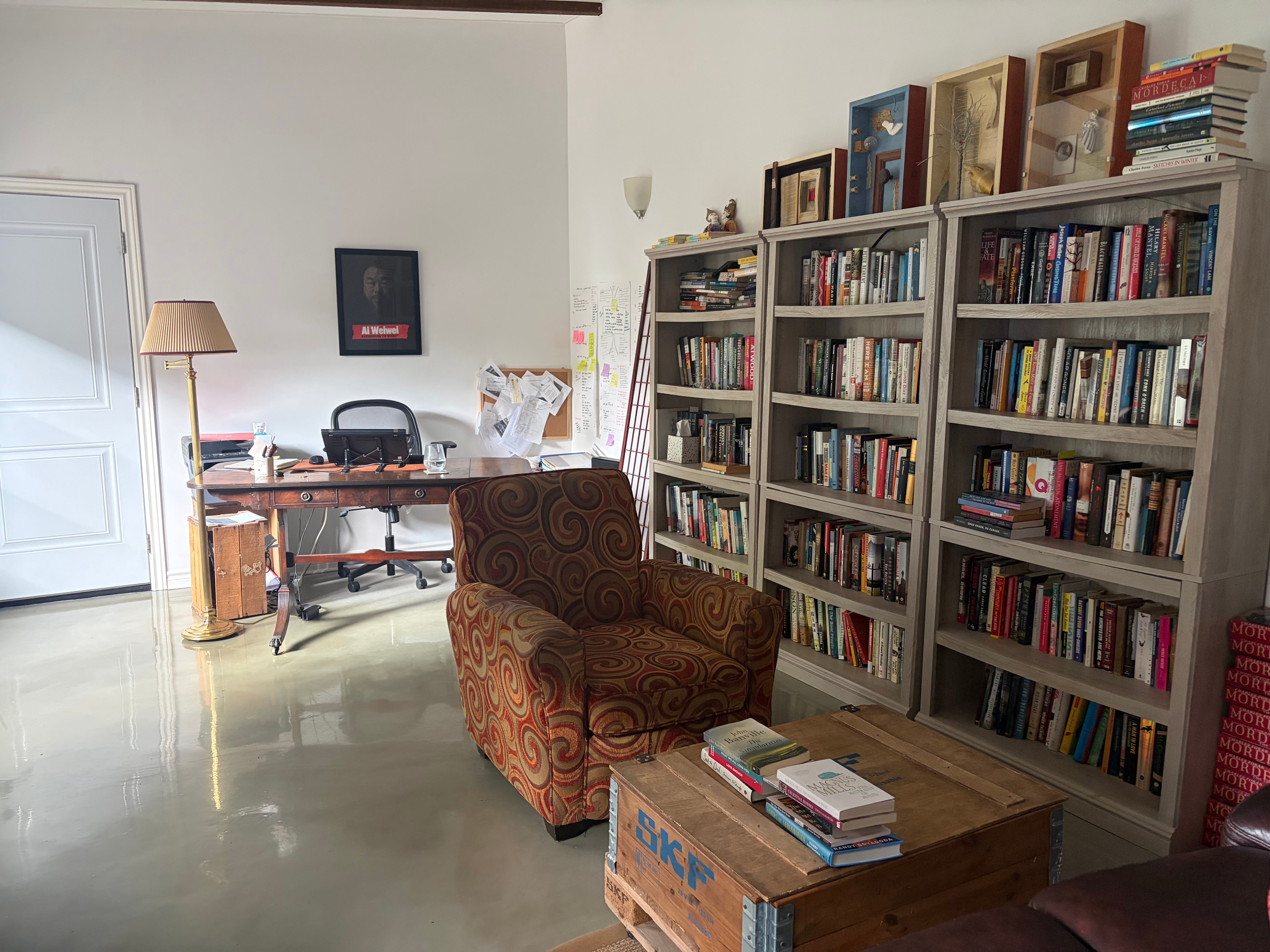
Printing everything out. Piles of papers, articles, drafts. Convinced still that I need to see everything in ink. Never looking at those pages again while also refusing to recycle a single one. Same for books. More books never to be read but essential, somehow, to my creative and intellectual well-being. Nonsense, in its 5th decade.
Are you a messy or a tidy worker?
See above.
I always like to talk about juvenilia. What sort of stuff were you making in your earliest career?
Was it any good? If not, when did it get good?
I published my first story as an undergraduate. I re-read it maybe a quarter century ago. Not great prose and for sure not precocious, not even close, but, well, there I was already – my sensibility, my concerns, my voice, albeit not-yet-dropped. My first ‘good(ish)’ story appeared when I was maybe 26. My first ‘good(ish)’ book was my first published book, at age 31.
How do you procrastinate? What’s your secret time-wasting pleasure?
I read around what I’m working on. I go missing doing research and, often enough, simple distraction. The Internet is a disaster for many more significant reasons than my susceptibility to it. But it is also ‘my’ personal disaster, writ small.
What parts of the internet in particular? I think we all have our own well-trodden paths and I want to hear yours. In detail.
Since I was a teenager, a good day has meant a couple of hours of reading, a couple of hours of listening to music, watching at least one film, reading at least one newspaper and magazine, plus one or two hours of sports. Oh yes, and writing for 3-4 hours. Pre-digital, I was often unable to keep this gonzo schedule for practical reasons. That was very much for the best. Now, well, there are no limits to what and when and where I can read/listen/watch. No limits, and way too easy access – sitting in my chair in my studio! Disaster, as I said.
What has been your greatest artistic moment? What about your lowest moment?
I woke up one morning at age 50 and had, to my astonishment, written a 700-page biography of Mordecai Richler. It had taken 4 years, but it felt a blur, all of it, and while I was touring the book non-stop for another year and watching it win a bunch of awards, I was still in that daze. Now, I pick up Mordecai, especially the hardcover, heavy as a laptop, and wonder – really? I did that?
If you had to live your life over but couldn’t be a writer, what would you be?
A musician. Music is the purer form; it is the dream of the dream of being awake in this world. Writing won out, I think, both because I am by nature argumentative and you need words for that, and because of One Hundred Years of Solitude, read the summer between high school and university. Marquez had constructed a cathedral the rival of Chartres or a temple city the equal of Angkor, and he’d done it using language and the force, urgency, humility of his own mind. I had to try constructing my own small houses of worship. I just had to.

